Cost of Platonic Co-Parenting: Build a Complete Budget
There is no single price for becoming a platonic co-parent. Your budget depends on the arrangement, treatment, legal requirements, location, coverage, and everyday care plan. Use written quotes and label unknown items instead of treating a broad estimate as an all-inclusive price.
Budget by phase
| Phase | Items to investigate | Who can clarify |
|---|---|---|
| Search and conversations | Memberships, travel, optional counseling or mediation. | Service providers; both prospective co-parents. |
| Legal preparation | Consultations, each person’s representation, drafting, revisions, donor or embryo documents, and later steps. | Appropriately licensed attorneys. |
| Clinical care | Consultation, screening, medication, monitoring, procedures, lab work, and cancellation fees. | Clinic and pharmacy. |
| Storage and future use | Renewals, transfer between facilities, thawing, fertilization where relevant, and future treatment. | Clinic or storage provider. |
| Pregnancy and parenting | Insurance costs, leave, childcare, transport, supplies, housing changes, and emergency care. | Insurer, employer, local providers, and your household budgets. |
ASRM’s egg-freezing cost guidance separates freezing, storage, and future use. Apply the same habit of separating stages when comparing quotes; do not assume one package covers later care.
Compare quotes on the same basis
- Record the quote date and how long it is valid.
- List included services and exclusions. Ask about medication, anesthesia, lab charges, and first-year storage.
- Identify the unit: per cycle, attempt, vial, embryo, year, hour, or document.
- Ask what happens financially if treatment is canceled, plans change, or an additional attempt is proposed.
- Keep possible insurance benefits separate from cash prices until coverage is confirmed.
A worked example
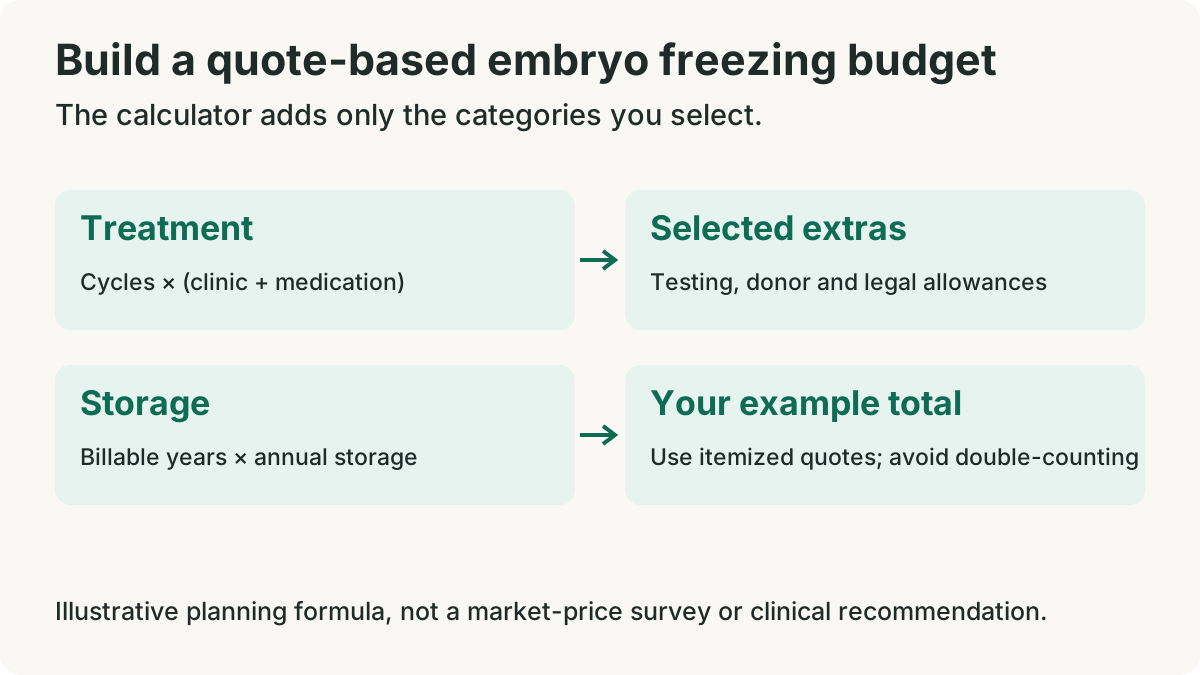
Illustrative arithmetic, not market pricing: suppose a written quote is $13,000 for a cycle and $5,000 for medication. Add a $2,500 legal allowance and five years of storage at $700 a year. The planning subtotal is $24,000: $13,000 + $5,000 + $2,500 + (5 × $700).
That example excludes later transfer, travel, time away from work, additional attempts, and parenting costs. If the clinic includes the first storage year, adjust the billable years. If either person’s legal scope is broader, replace the allowance. These numbers are calculator defaults, not verified national averages.
Discuss how expenses will be handled
Record the expense category, proposed payer, payment timing, and what happens if an invoice is higher than expected. Distinguish an intended cost split from obligations that applicable law may impose. Ask counsel to explain the relationship rather than assuming a spreadsheet creates a binding arrangement.
Hypothetical example: treatment may be discussed as an equal split, while travel and unpaid leave remain unsettled. Keep each item on a separate row so a single agreement about “costs” does not hide those differences.
Verify coverage and legal scope
Use ASRM’s coverage resources to start your questions, then confirm your actual plan with the insurer and employer. Ask about authorization, network restrictions, and which services qualify.
Request written legal quotes for the complete proposed scope. The AAAA directory is a starting point for finding counsel, not a price guide.
Turn unknowns into the next tasks
Mark each item as quoted, an example allowance, or unknown. Use the calculator for a treatment subtotal and the toolkit spreadsheet to organize categories and proposed payers. Revise the budget when quotes or plans change.
Free seven-day preparation course
One short email a day covering roles, costs, consultations, agreements, and conversation topics. Confirm your email address to start.
Continue reading: Questions about legal scope · Freezing and future-use costs · Money conversations